
What Visual Supports Are and How to Use Them
Surely, at some point in our daily lives, we have come across an image that provides instructions on how to carry out an action; for example, the use of a fire extinguisher...
Surely, at some point in our daily lives, we have come across an image providing instructions on how to carry out an action; for example, the use of a fire extinguisher. These types of elements, which combine text and images, constitute a form of visual support. Let us look at more details below.
What Support Means
In a general sense, the concept of support in the psychoeducational field refers to any tool that can be useful in reinforcing a learner’s skills, helping them perform an action more effectively while contributing to their autonomy and well-being.
Types of Support
There are different types of support that can be provided, depending on the task, circumstance, or need; among them, we have:
- Physical support: the learner is guided to perform the task; for example, when cutting with a knife, the adult places their hand over the child’s hand to help guide the movement.
- Modeling support: in this case, the adult performs the action in front of the learner, prompting them to make the same movements; for example, when folding a T-shirt.
- Gestural support: gestures are made to prompt the expected response; for example, while bathing, glancing toward the soap to suggest they reach for it and lather up.
- Positional support: providing assistance by placing items closer to facilitate the task; for example, moving a sock closer so the child can put it on.
- Verbal support: giving instructions or reminders so that the actions are carried out.
Visual Supports
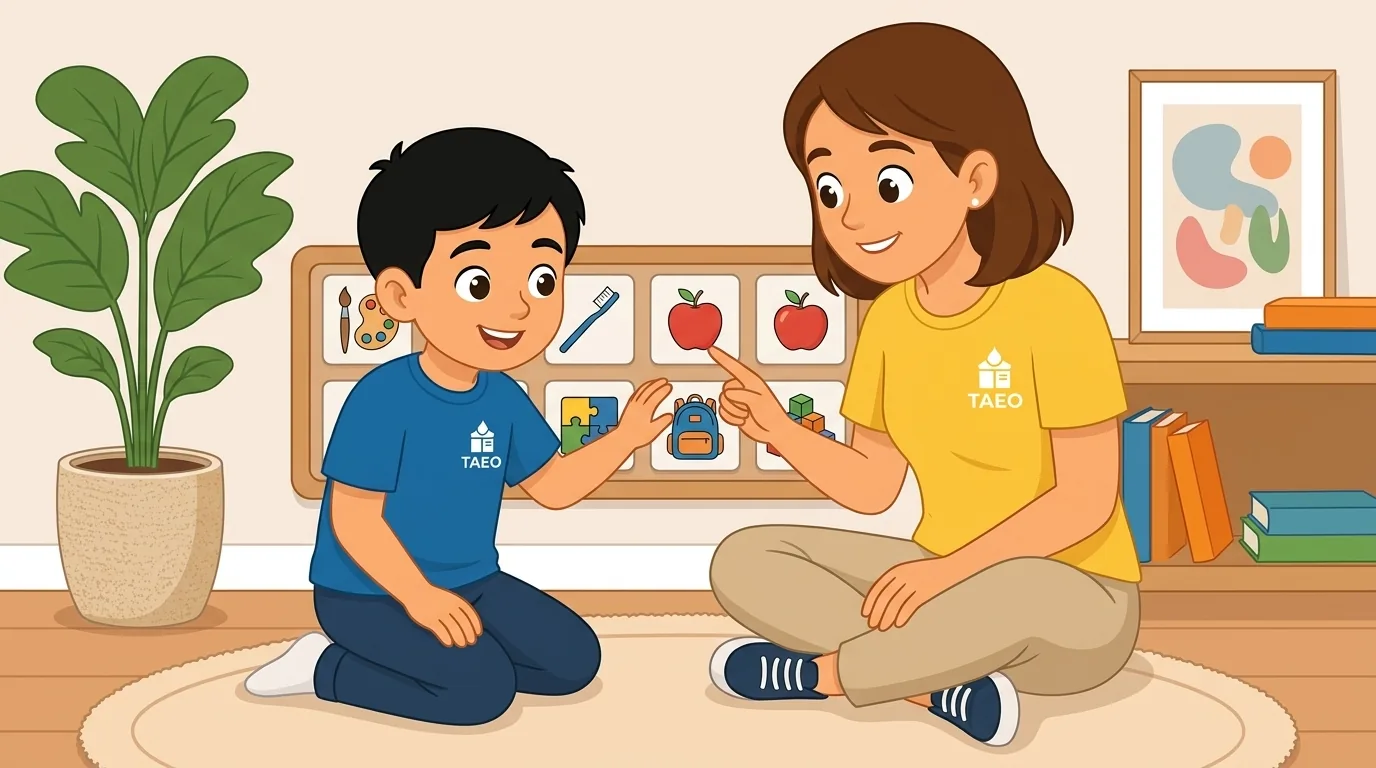
In addition to those mentioned above, there is also visual support. This consists of displaying an image or an object to remind the learner to exhibit a certain behavior, or even how to carry it out.
Such visual support can appear in the moment or, preferably, should be present in the setting where the behavior is required. Along with the image, it may also include text to complement or expand upon the information.
Among the various forms of visual support are:
- Cards
- Social stories
- Checklists
- Task chaining
- Expected behaviors in diverse contexts
- Sequences of expected behaviors
- Schedules
- Work systems
- Display boards
- Visual schedules
- Maps
- Diagrams
- Expected behaviors
- Flowcharts
It is recommended that, when creating any of these visual supports, one must be very precise, avoiding cluttering the images with excessive detail or using too many images. The goal should be to synthesize processes so they are easy to visualize, understand, and remember.
When and How to Use Them
A visual support may be needed in various circumstances, such as:
- With learners who have lower linguistic skills or are in the process of consolidating them;
- For completing tasks that may prove complicated or to help visualize behavioral chains;
- With individuals who require a form of structured learning;
- Or as a simple reminder of tasks, helping reduce the likelihood of problem or challenging behaviors arising.
Furthermore, these types of supports can be used by various people—including parents and adult caregivers, teachers, and psychology and psychoeducation professionals—to better organize time and develop strategies, even when managing situations of frustration or anxiety, or when communication difficulties are present.
However, it is important to emphasize that visual supports are truly effective to the extent that they are part of a plan; that is, when they are used in a contextualized manner, in response to concrete and realistic learning objectives—goals that can be achieved by the child.
Otherwise, generic posters or pre-made materials are not always suitable for the learner’s context or their particular needs. Visual supports must respond to a clear intention within an orchestrated plan designed to foster desired behaviors, or to consolidate or develop lagging skills.
Therefore, it is best to design them ad hoc; additionally, their implementation requires supplementary support (for example, verbal prompts) so that the child understands what the resource refers to and what is expected of them.
Benefits of Visual Supports
There are diverse benefits to using visual supports, both for the learner and for task performance. Among these, we find:
- They can stimulate different cognitive and metacognitive skills: observation, attention, perception, memory, planning, among others.
- They contribute to the generalization of desired or expected behaviors.
- They provide strategic tools for carrying out tasks.
- They provide a structured work system, especially for individuals who need greater predictability.
- Consequently, they reduce interfering behaviors that hinder performance.
- They help reinforce life skills and equip the learner to better handle various challenges that arise.
- They also positively impact emotional and behavioral well-being, helping reduce stress associated with task execution.
- They foster autonomy.
- They enhance self-efficacy, which in turn strengthens self-esteem.
Finally, according to several studies on the topic, the use of images contributes to successful psychoeducational intervention for individuals with ASD, ADHD, and other conditions.