
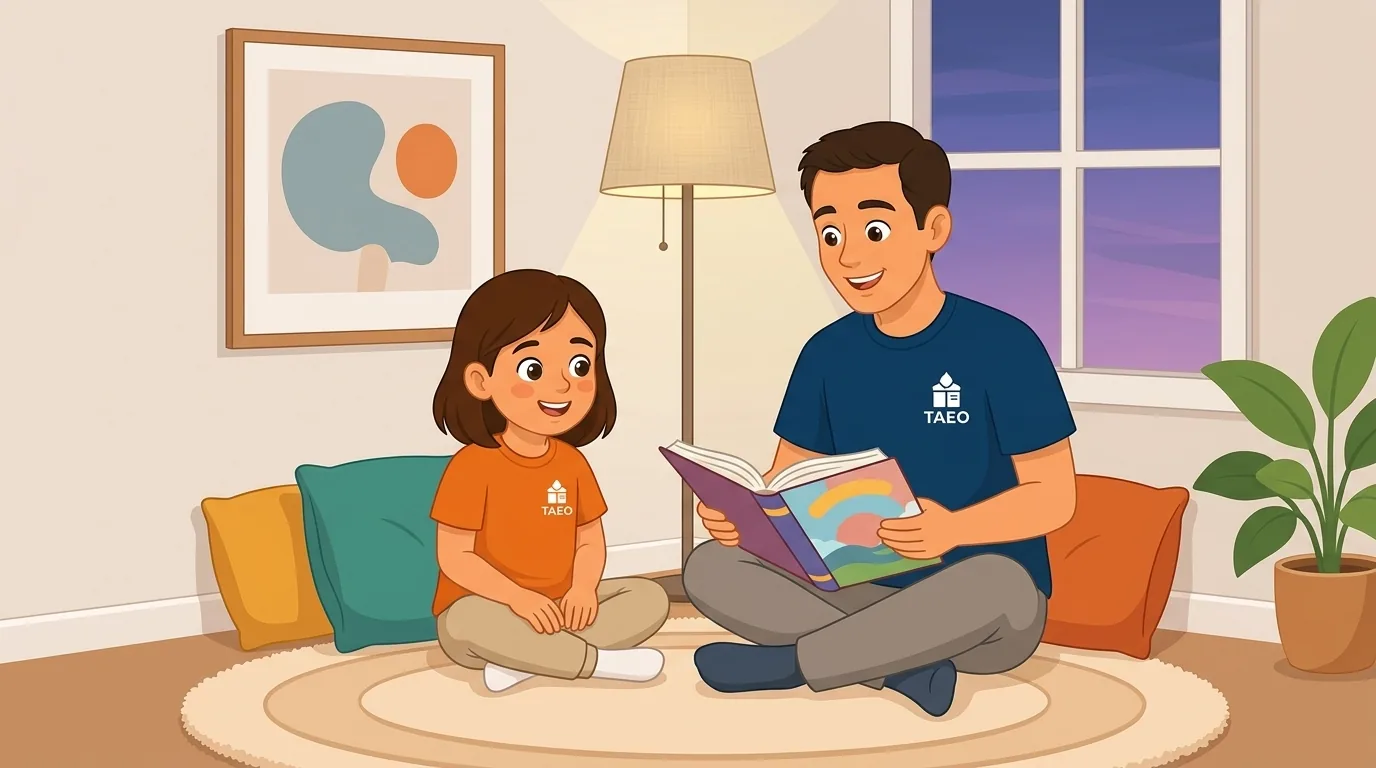
Why Reading Stories to Children Is Beneficial
Although it may not be a common practice today, reading stories to children offers significant benefits. Both classroom teachers and parents can and should make it part of…
Although it is not a common practice nowadays, it is important to recognize that reading stories to children is beneficial. And this is something that both teachers in the classroom and parents at home can and should do, whether at bedtime or at any other moment throughout the daily routine.
Below, we explore some of the reasons why reading stories to children is considered so beneficial.
1. Disconnecting from Devices for a While
The time our children spend with electronic devices is steadily increasing, and the age at which they begin interacting with them is becoming younger and younger, which can bring about several unwanted consequences.
According to experts, these range from limitations in language development and social skills to issues related to obesity. However, the beauty of reading stories to children is that for a little while, their eyes, hands, and back get to rest, allowing them to relax and simply listen.
2. Developing Thought
In his book Homo videns, Giovanni Sartori warned of the risks of a society dominated by audiovisual consumption, arguing that homo sapiens owes much of its knowledge and the progress of its understanding to the capacity for abstraction. The foundation of this is precisely words, as human language is symbolic, evoking mental representations and prompting the mind to reconstruct ideas.
However, according to the author, this process atrophies when conceptual-abstract language is entirely replaced by perceptual-visual language, which is more concrete and less complex in terms of richness of meaning. Thus, cognitive abilities gain both qualitatively and quantitatively when an individual, through reading—whether read aloud or silently—must make a mental effort to represent the concept of what is being conveyed.
3. Stimulating the Imagination
In the same vein, narratives serve as powerful stimuli for the imagination, insofar as they suggest or present the recreation of fantastic, wondrous, and fictional yet plausible elements, regarding which the reader-listener must construct the image in their own mind, as noted in the previous point. Best of all, they must develop their own vision, which in turn fosters independent thinking.
4. Vocabulary Acquisition
While we can certainly acquire vocabulary through everyday conversations and by watching videos across different platforms, narratives provide an endless wealth of new words, especially when set in time periods or contexts different from our own.
5. Stimulates an Interest in Reading
Reading with and to children constitutes a set of practices that support the learning of reading, as it creates a space where they actively interact with the text. When this begins at an early age, children view books as an integral part of their living environment, adopting reading as a regular and enjoyable practice.
6. Improves Attention
Reading stories to children is also beneficial for higher psychological processes, specifically regarding the expansion of children’s attention spans, by encouraging them to sit and listen to a story for a period of time without the overload of visual stimuli and without constantly shifting from one piece of content to another.
7. Quality Time with Your Children
And as if that were not enough, reading creates an intimate space that helps strengthen the relationship between parents and children, allowing them to enjoy quality time together without being isolated with their eyes glued to a screen.
CEO of the