
What Parents Can Do for Their Children's Inclusion
Just as we have emphasized that the responsibility for inclusion rests not on special education—or not solely on it—but much more on regular schools, we must not forget that...
Just as we have emphasized that the responsibility for inclusion rests not on special education—or not solely on it—but much more on regular schools, we must not forget that the family and, particularly, parents play a decisive role.
While therapeutic intervention is the purview of psychoeducational professionals, it must take place within the framework of a plan, an orchestral vision generated from within the family, which should promptly seek out these services whenever they observe that learning is not taking place, or is not progressing as it should.
Thus, the first step is to seek the necessary therapeutic or psychoeducational services; the second, to understand that not everything is the therapist’s job. And the third is to understand what the family can do at home—and, even more importantly, to do it.
Inclusion Begins at Home
Inclusion begins at home. This phrase, which emerged within our psychoeducational organization almost like a revelation, has led us to understand that families must be supported in every sense, and that in turn they must take on a leading role in the process.
In this regard, in this article we want to propose several practical recommendations that parents can use to work toward achieving full educational and social inclusion for their children. Let us explore them.
Fostering Autonomy
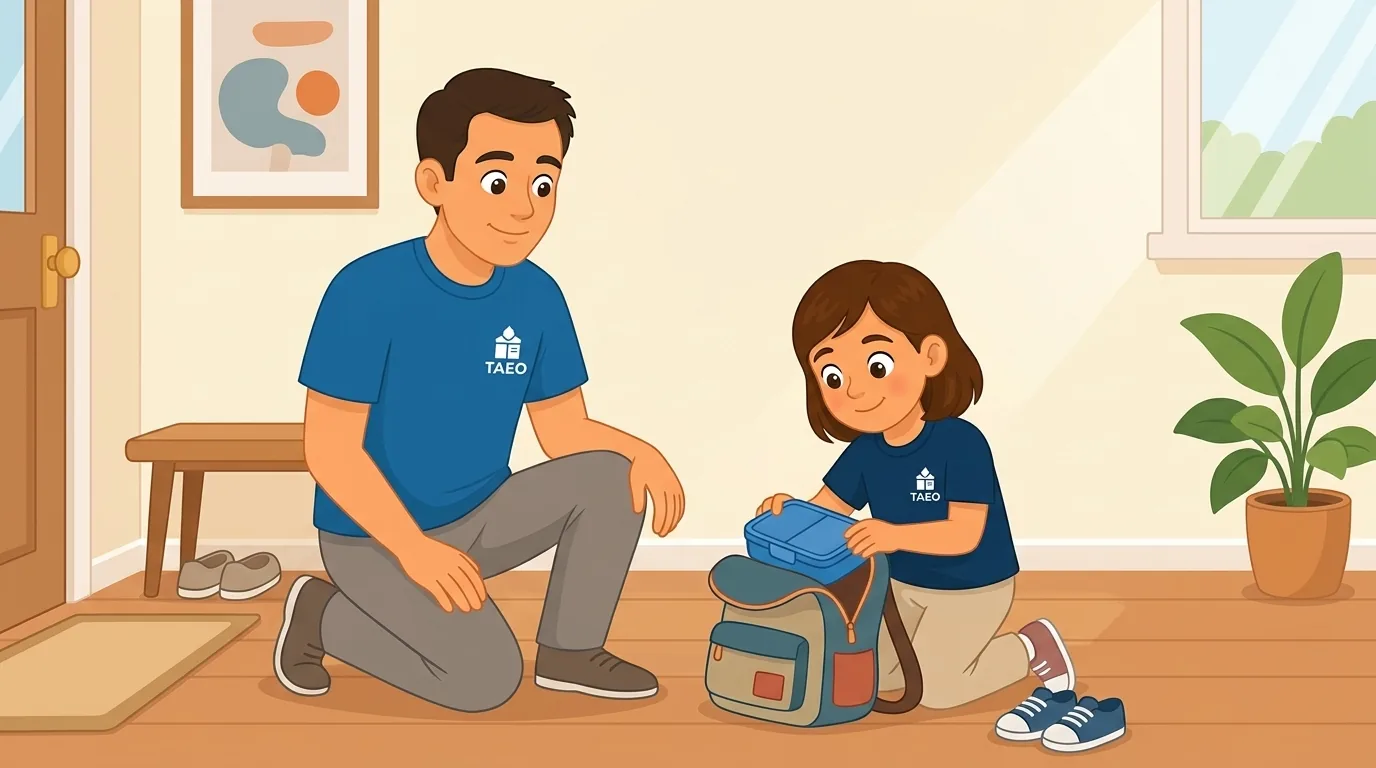
You can begin by fostering the child’s autonomy through the performance of small tasks related to themselves and to their interaction with their environment. In this sense, time and effort must be devoted to developing functional skills, which will support their self-determination. We refer to actions related to personal hygiene, grooming, dressing, caring for personal belongings, and eating, among others.
Chaining
For the above, several procedures are essential. For example, chaining (Miltenberger, 2013). This consists of breaking down an activity into small tasks and teaching them to the child, from the first step to the last (forward chaining) or starting from the final step in the sequence back to the first (backward chaining).
This will contribute to the development of the target skill: using a cup or a glass, handling cutlery; taking off and putting on socks and shoes; undressing and dressing (underwear, pants, shirt); bathing, brushing teeth, or whichever skills are selected for instruction.
Offering Prompts and Reinforcement
Both during chaining and at other times, it is important for parents to offer physical or visual prompts. In other words, providing help through examples or visual cues that prompt the expected behavior, preferably avoiding verbal prompts.
Likewise, each step in the chain should be reinforced to increase the occurrence of the behavior, contingently delivering an item or activity previously identified as a reinforcer.
Putting Learning into Practice
It is also indispensable to present the child with situations that require the deployment of learned skills, or put differently, to encourage their active participation in everything inherent to their daily life.
Routine and Structure
Another recommendation is to establish a routine that is not only followed, but also visually observable, to facilitate the child’s comprehension while making it predictable—fostering anticipation and, with it, the display of expected behaviors.
Regarding this, the contributions of structured teaching point to the necessity of organizing the environment through visual stimuli, since many children benefit greatly from these types of tools.
Meaningful Planning
Planning will only be meaningful if it directly relates to what actually happens day to day. In this sense, it is important that this routine becomes part of that microcosm called the family, and that whatever tasks the child is asked to perform make sense within the family’s unique dynamics.
Naturally, each family group determines for itself what constitutes its authentic functioning; and within that space, room must be made for the child to participate and learn.
Verbal Operants
On the other hand, it is necessary to encourage the emergence of socially accepted verbal operants, creating the need to communicate, which is fundamental. That is, placing the child in situations where they need to rely on language, rather than resorting to crying, shouting, or screaming.
Starting from communicative intent, appropriate verbal behaviors must be developed, from increasing vocalizations and words, to making requests, asking for information through questions, structuring sentences, providing relevant answers, and participating in spontaneous conversations.
Additionally, an augmentative or alternative communication system can also be considered for non-speaking children. This system can be augmentative when it serves as a scaffold for the development of vocal verbal behavior.
Play
Along the same lines, children need to develop interaction and play skills that will ensure their participation and learning across all contexts. Regarding play, the initial goal should be for the child to use toys functionally and display variety in the actions performed with them; followed by playing with adults, tolerating the presence of other children, and ultimately participating in cooperative games (Fernández Valdés, 2007).
Interaction
Regarding interaction, several key skills must be nurtured, such as:
- accepting and asking for help,
- giving and receiving compliments,
- offering and accepting constructive feedback,
- following suggestions,
- observing and managing play situations,
- showing reciprocity,
- sharing leadership,
- maintaining and concluding interactions.
And at all times, work must focus on developing empathy and the ability to resolve conflicts appropriately.
Imitation: A Keystone Skill
For everything suggested above, developing imitation is essential; imitation is considered a behavioral cusp, enabling countless new learning opportunities (Rosales-Ruiz & Baer, 1997).
Initially, modeling prompts can be used to help build more complex actions; gradually, generalized imitation will ensure learning in natural situations, which is the ultimate goal.
Sensory Stimulation
From early ages, parents are encouraged to gradually expose the child to various sensory stimuli, since the combination of all sensory input is what allows us to perceive the world around us (Ayres, 2006).
Indeed, moving and interacting, as well as most daily activities, require all senses working simultaneously—not only the five commonly known senses, but also the vestibular and proprioceptive systems.
- The sense of sight should engage with images, shapes, colors, and lights;
- hearing, with different musical and environmental sounds, and voices of varying tones and volumes;
- smell, with diverse aromas;
- touch, through varied textures and temperatures;
- taste, with sweet, salty, sour, and bitter flavors;
- the vestibular sense, through activities such as crawling, climbing, walking, running, bouncing on a lap, swinging on hammocks or swings, jumping, and walking on balance structures, among others;
- finally, regarding the proprioceptive sense, it is beneficial to encourage the child to adopt different body postures, asking them to identify body positions with eyes open and closed, and to engage in activities like hugging, petting, throwing with force, and lifting objects of varying weights.
Harmoniously integrated sensory processing promotes the child’s participation and learning; therefore, proper development should be fostered through familiar stimuli in the home, enabling the child to tolerate, enjoy, and actively participate in situations involving them.
Empowerment Through Knowledge
Everything discussed so far demands a series of actions that depend fundamentally on the family, establishing the necessary supports. In the framework of inclusive education, this refers to planning as many activities and situations as possible for everyone, honoring the diversity represented in each member—in this case, within the home.
Although therapeutic intervention is the domain of professionals, an empowered family that leads with knowledge becomes the orchestral conductor, guiding both the actions that directly fall under their responsibility and those connected to professional guidance aimed at overcoming potential barriers.
It is worth clarifying that psychoeducational and therapeutic services are enlisted to provide the necessary mechanisms so that, whether in therapy or in real-life contexts, the child can acquire skills not yet built in natural settings. However, once learned, there must be countless “real-life” opportunities where these skills are progressively put into action.
For this reason, families must empower themselves with both knowledge and action, because one cannot act blindly: professionals must be consulted whenever an assessment or intervention is needed, and targeted, purposeful support must follow.
Naturally, there must be close collaboration and communication among the family, the psychoeducational provider, and the school, along with clearly defined roles: certain actions belong to professionals, others to parents, and all must converge on facilitating the child’s active participation in real situations—that is, in natural spaces and everyday life.
As UNICEF (2013) notes, service providers “should seek to provide families with the necessary knowledge, skills and support… they should work closely with families to design and implement culturally appropriate interventions and meet their needs.”
Believing in Autonomy
If a family living with someone who has a diagnosed condition, a sensory limitation, or reduced mobility believes that this person cannot handle everyday household tasks, then inclusion is not starting at home; quite the contrary.
Therefore, we must believe in autonomy and in our children’s capacity to navigate their home environment; because what they think of themselves when they are at school or in a future workplace will depend directly on this. And this applies to all people, without exception.
In short, if children are led at home to believe they lack the capacity to take on responsibilities and care for themselves, they will not do so in the classroom, nor will the family or the children demand their rightful place as fully included, full-fledged members of the school community.